
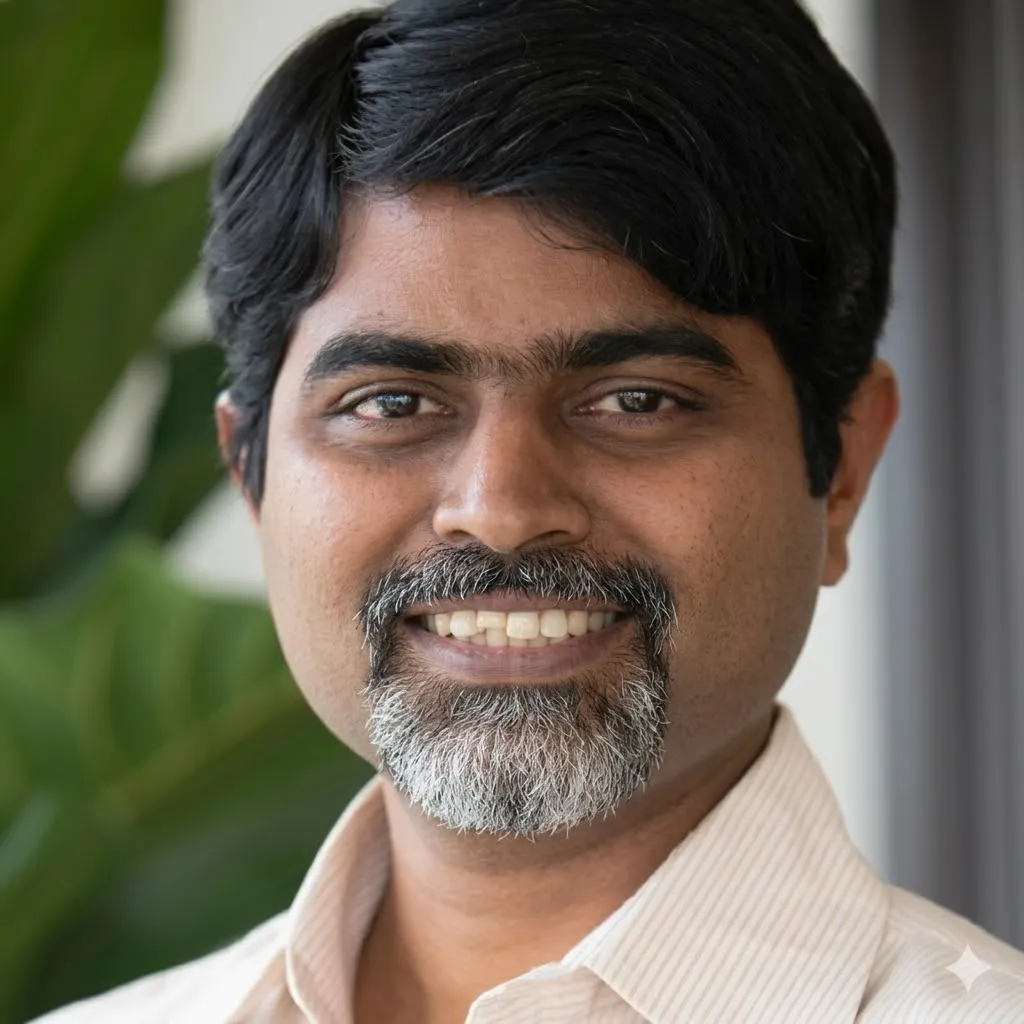
Origin
I come from Mumbai, India. These days I am in Hürth, near Cologne, Germany.
I graduated as an electronics engineer from Mumbai University in 2002. I stumbled into software because, after the 9/11 attacks of 2001, jobs dried up and a financial crisis loomed. The software industry was the first to hire. I have been building production systems ever since.
I came to Germany in 2023 because my wife was transferred. I like to travel, and the startup, software, and climate tech scene here? Das gefällt mir. I am staying.
I speak five languages at varying levels of decline: English native, Hindi and Marathi native, Konkani conversational, German at B1 and counting.
How I build
I am, by nature, a builder. Most of my work starts the same way: a whiteboard or a napkin drawing, a founder saying, "I have an idea that needs software to give it life." Within a few months, that idea becomes a working prototype. And prototypes, when they solve something real, attract users, funding, and a team.
When the system already exists, and the team is hitting the ceiling of what the current architecture can carry, the same instinct applies. I sit in a room with a founder or a CTO and a few senior engineers, and we take it apart together until we can all see what is actually there. Then we put it back together, sequenced, in a way the business can scale and the team can execute.
I work with companies that have found their footing and need to build the systems that carry them through the next phase without breaking what is already working.
What I believe
We shall ask WHY before we ask HOW.
We shall build for outcomes, not features.
We shall build by principles, not by whim.
We shall keep it simple and stupid.
We shall prototype before we commit.
We shall build with grit, spit, and a whole lot of duct tape.
We shall deploy what works.
We shall learn from failures.
We shall rise after every hit.
We shall run further than a marathon.
The career arc, briefly
My first big job out of university was at Infosys, in their Banking & Capital Markets group. That is where I got my first global exposure: on-site in Richmond, Virginia, for a major US bank, harmonising a relational data model across 500+ tables.
2006 took me to Lehman Brothers in Mumbai. I survived the 2008 bankruptcy. Met my future co-founder there.
At Nomura I stayed with the same team, working in the same building. A few years later, in 2011, I co-founded Inbotiqa with the colleague I met at Lehman.
Earlier: HDFC Life Insurance (early serverless, 2015), Progress Software (2011).
Connect with me on LinkedIn; drop a note when you connect, or I might filter you as spam.
Speaking, writing, mentorship
I write for JavaPro and Baeldung, two names every Java professional recognises.
Select articles
- Bridging Java and Python for AI/ML in Production: The Case for GraalPy on GraalVMJavaPro
- Greener Code: Sustainable Java Deployments with Native Builds and Knative Serverless on KubernetesJavaPro
- How to Secure Ollama ServerMedium
- Flutter ain't going awayLevel Up Coding
- Why you shouldn't use Langchain's indexing API?Level Up Coding
- Baeldung Author PageBaeldung
Off the clock
I trek, I travel, I write — in order of increasing frequency. I travel mostly by public transport. I cook rarely, badly, and enthusiastically (all three are related). I live to eat. I am, like every self-respecting Indian, a fan of spicy food, particularly the Malwani style Bombay duck, which is a fish, not a bird, named after my hometown. Yes, it confuses everyone.
I like stories presented on a bigger screen. I watch Bollywood and Hollywood movies. I grew up listening to music from Kishore Kumar, Asha Bhosle, and R.D. Burman, and am now trying to make sense of German music. The Mahabharata, R.K. Narayan's condensed English version, is the one book that has stayed with me. As a kid, I was fascinated with technology. I always wanted to take things apart and put them back together. I called it reverse engineering. These days, I explore software builds with the same curiosity and write what I learn, sometimes with metaphors and analogies from Hollywood or Bollywood movies.
If you have an idea that needs software to give it life, talk to me.